National Career Guidance Awards 2024-2026
1. National Career Guidance Awards 2025
 In 2025, the competition was held for the seventh time, running from 6 May to 25 June. Participants could submit applications to showcase their own achievements or nominate outstanding initiatives by others, with collective submissions also welcome. In total, ten applications were received.
An impartial jury – comprising representatives of the National Guidance Forum and the State Education Development Agency – evaluated the submissions based on the significance of the practice, its innovative elements, and the geographic reach of its impact.
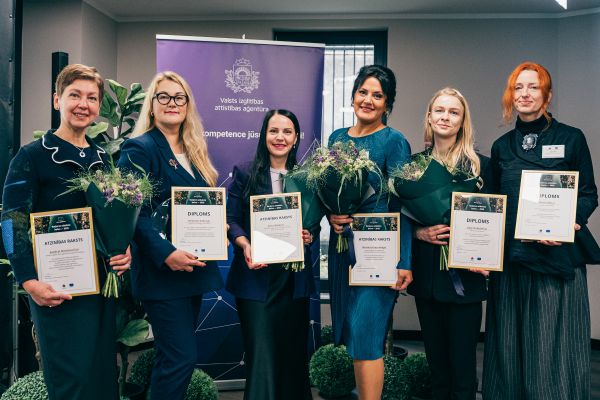
Three authors of exceptional products in careers education and career counselling received the 2025 National Career Guidance Award:
- Kristīne Kalniņa, career counsellor at Jelgava Secondary School of Technology, for creating the “Talent Classification Cards,” a tool designed to help identify abilities, strengths, and talents across different age groups.
- Līga Rubuļņika, career counsellor at Rēzekne Technical School, for developing an online career aptitude test and adapting it to the school’s educational programmes.
- Dace Siliņa, career development project manager and career counsellor at the Career Centre of the University of Latvia, for designing the elective course “Development of Career-building competences” at the University of Latvia.
Additionally, Certificates of Appreciation were presented to Elīna Bulāne, Sandra Dimitroviča, and Maruta Krasnobaja for their notable contributions to the field of career guidance. Conference participants also had the opportunity to explore the award‑winning initiatives during the thematic masterclasses and workshops.

Co-funded by the European Union. Views and opinions expressed are however those of the author(s) only and do not necessarily reflect those of the European Union or EACEA. Neither the European Union nor the granting authority can be held responsible for them.